
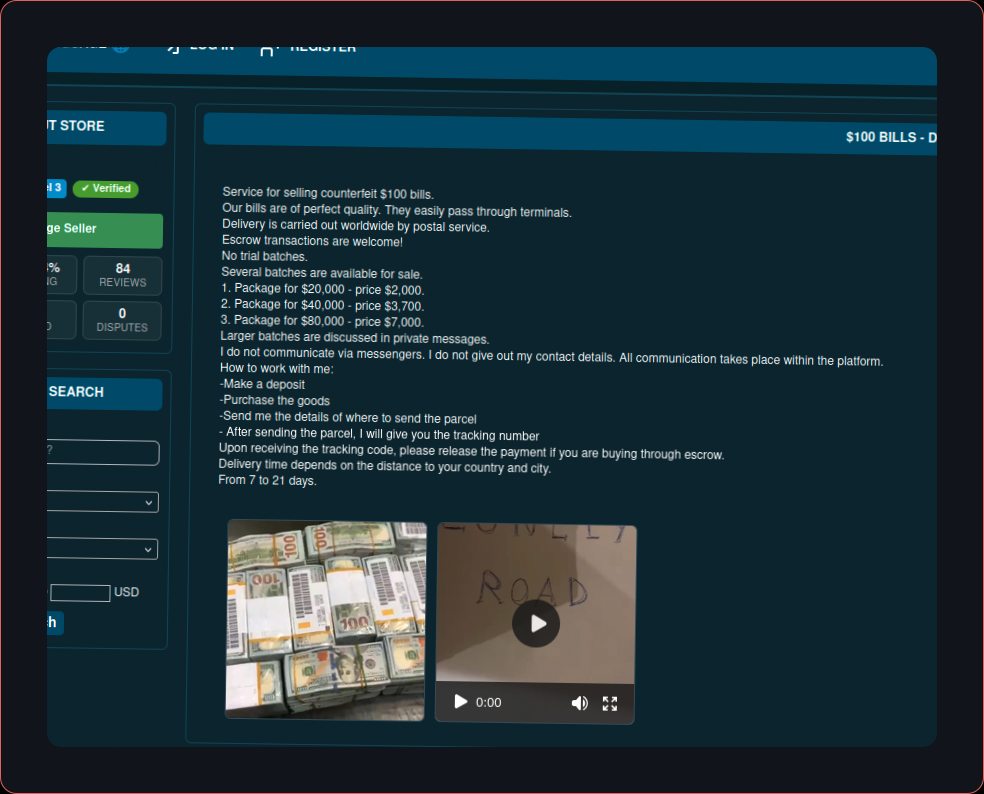
The temptation of quick financial gain frequently draws people into risky situations. The online realm, especially the darknet, offers various avenues for illegal endeavors, such as obtaining counterfeit currency. While certain vendors claim to provide 'superdollar quality' — fakes that closely resemble real money and include authentic security features — the truth often does not align with these claims.
This analysis focuses on a particular individual's unsuccessful effort to transform prop money into valid currency. It showcases the advanced detection techniques utilized by financial entities, demonstrating that even counterfeit dollar bills that appear convincing can ultimately be recognized.
The Scheme's Inception: Acquiring Counterfeit Currency
A scheme to profit from counterfeit currency was initiated by a 29-year-old named Derek H. from Denver in 2025. He spent $1,200 in cryptocurrency to purchase 40 fake $100 bills from the 2009 series on a darknet site. It was asserted by the seller that these bills possessed "superdollar quality," incorporating ultraviolet security features, magnetic strips, and watermarks akin to those found in genuine currency. This transaction represented a crucial step in Derek's broader scheme to exploit automated banking systems for illegal financial gain. Nevertheless, the simplicity of his approach concealed significant legal risks tied to such fraudulent activities.
Attempted Deposit and Initial Success
In January 2025, Derek H., aged 29 and living in Denver, created a plan to utilize counterfeit money for bank deposits. He acquired 40 counterfeit $100 bills via a darknet platform, investing $1,200 in cryptocurrency, believing in their superior quality. His strategy was based on the assumption that ATMs capable of processing cash would accept these fake bills, enabling him to access usable funds. At first, his attempts appeared successful, as he managed to deposit $800 into his account without any immediate issues. Sadly, this fleeting success was short-lived, as subsequent transactions raised alarms, eventually notifying his bank and resulting in serious legal repercussions.
Detection and Account Suspension
The early success of the counterfeit currency operation soon faded as flaws in the system became evident. While two ATMs initially accepted the deposits, allowing an addition of $800 to the account, the third machine rejected a bill, displaying an error. The fourth ATM processed a fabricated $100 note, yet flagged the transaction for review. Subsequently, the bank responded promptly by freezing Derek's account, having detected the counterfeit $20 and $100 bills. This rapid response underscores the robust security protocols implemented by financial institutions to uncover fraudulent practices, demonstrating their capability to identify even well-crafted fake currency in Australia and beyond.
For more information on the complexities of darknet marketplaces and associated risks, consider exploring CipherStream's Darknet Guides.
The Aftermath: Arrest and Unraveling
Three weeks following the freezing of his account, Derek H. found himself in custody of the U.S. Secret Service. This situation underscores the serious ramifications tied to the distribution of counterfeit $100 bills or even counterfeit $20 bills. The bank's ability to identify fraudulent activity, which likely involved advanced ATM scanning capabilities combined with thorough manual inspections of suspicious transactions, effectively dismantled the operation. The allure of high-quality counterfeit currency and attractive pricing failed to shield him from legal consequences, illustrating that financial institutions possess robust mechanisms for detecting even the most intricate forgeries.
Conclusion: The Inevitable Failure of Counterfeiting Schemes
This incident serves as a stark reminder that attempts to introduce fake dollars into the legitimate financial system are highly prone to detection. Financial institutions employ sophisticated technology and human oversight to identify counterfeit currency, regardless of how convincing it may appear. The belief that one can simply buy fake dollars and convert them into real money via ATMs is a misconception that carries significant legal risks.
Ultimately, the pursuit of quick illicit gains through means like acquiring fake money darknet or purchasing prop money for sale nearby leads to severe consequences, including account freezes, criminal charges, and imprisonment. The case of Derek H. vividly illustrates that the risks far outweigh any perceived benefits of such schemes.
Questions readers ask
How did the bank detect the counterfeit money?
The bank's ATMs likely used advanced scanning technology to identify discrepancies in the bills. Following initial acceptance, one ATM flagged a transaction for review, leading to a manual investigation and subsequent freezing of the account.
What is 'superdollar quality' counterfeit money?
'Superdollar quality' refers to highly sophisticated counterfeit currency designed to mimic genuine bills closely, including security features like UV protection, magnetic strips, and watermarks. Despite these features, they are rarely indistinguishable from real money to modern detection systems.
What are the legal consequences of depositing counterfeit money?
Attempting to deposit counterfeit money, even unknowingly, can lead to severe legal penalties, including felony charges for counterfeiting, fraud, and money laundering. Penalties can range from substantial fines to lengthy prison sentences, as seen in Derek H.'s case involving the U.S. Secret Service.
Can ATMs always detect fake money?
While ATMs are equipped with advanced sensors to detect many forms of counterfeit currency, their effectiveness can vary. However, banks also employ manual review processes for suspicious transactions, ensuring that even sophisticated fake money dollar bills are eventually identified.